

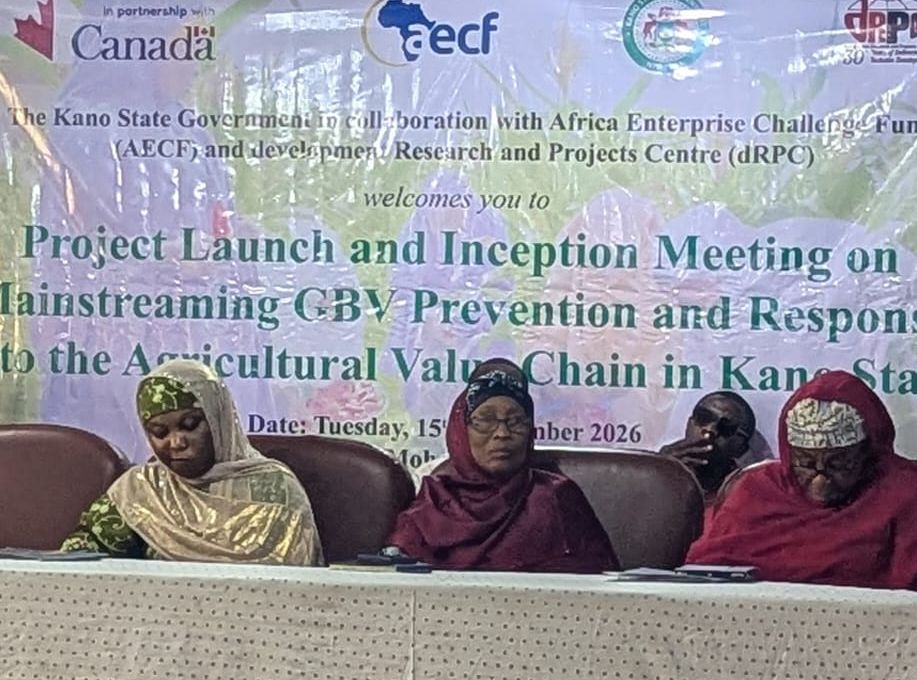
dRPC, partners mobilise gender champions to tackle GBV in Kano
The development Research and Projects Centre (dRPC), in collaboration with the African Enterprise Challenge Fund (AECF) and Global Affairs Canada, has commenced the mobilisation of traditional and community leaders as gender champions to tackle gender-based violence (GBV) in Kano State.
The initiative is aimed at mainstreaming GBV prevention and response into agricultural value chains, particularly in communities where AECF-supported enterprises operate.
A representative of dRPC, Hajiya Aisha Bello, disclosed this during the launch of the initiative, titled: “Mainstreaming Gender-Based Violence Prevention and Response into Agricultural Value Chains in Kano State.”
Bello said the 12-month project would work with communities to strengthen local capacity for preventing and responding to GBV, while creating safer and more inclusive environments for women and girls participating in agriculture.
She said the initiative would include training and engagement of community leaders and gender champions, community sensitisation campaigns, promotion of positive social norms, strengthening of referral pathways for survivors and fostering community ownership of GBV prevention efforts.
The launch, held during a high-level inception meeting in Kano, attracted government officials, traditional and religious leaders, civil society organisations, women leaders, agricultural stakeholders, development partners, community representatives and the media.
Speaking at the event, the Commissioner for Women Affairs, Children and People with Special Needs, Hajiya Amina Abdullahi Sani, said Kano had received an award of excellence for adopting the Women’s Economic Empowerment (WEE) policy.
She said dRPC had played a significant role in advocating the domestication of the policy in the state.
According to her, the ministry recognises dRPC and AECF among organisations actively supporting the fight against GBV and promoting women’s economic empowerment.
She also said the domesticated Violence Against Persons Prohibition (VAPP) Law was expected to be signed into law after its passage by the Kano State House of Assembly.
The commissioner said addressing GBV was essential to achieving meaningful economic empowerment for women and girls.
Stakeholders at the meeting noted that women constituted a significant proportion of the agricultural workforce and contributed substantially to food production, processing and marketing.
They, however, observed that discrimination, harassment, harmful social norms and other forms of violence continued to undermine women’s productivity, wellbeing and economic advancement.
They stressed that GBV was not only a human rights concern but also an impediment to agricultural productivity, economic growth and sustainable development.
A major highlight of the meeting was the commitment by stakeholders to identify and train community leaders and gender champions who would serve as advocates for behavioural change and agents of social transformation in their communities.
The participants said the initiative was timely, especially with the increasing emphasis on women’s participation in agricultural and economic activities.
They called for stronger collaboration among government institutions, traditional and religious authorities, civil society organisations, development partners, the private sector and communities to ensure sustainable impact.
Representatives of traditional and religious institutions pledged to mobilise their communities, challenge harmful social norms and promote values that protect and empower women and girls.
Similarly, the leader of the Women Farmers Association, Hajiya Sayyada Sharif, pledged the association’s support for the initiative.
“We will ensure that all hands are on deck to ensure that the aims of the project are achieved by engaging the right stakeholders,” she said.
In her closing remarks, Bello appreciated stakeholders for their participation and commitment, saying the success of the project would depend on strong partnerships and community ownership.
She said the initiative was expected to reach thousands of community members across Kano State and contribute to safer, more equitable and gender-responsive agricultural systems.
The project will also strengthen existing mechanisms for preventing and responding to GBV while promoting women’s participation in agricultural value chains.
============ END ============